

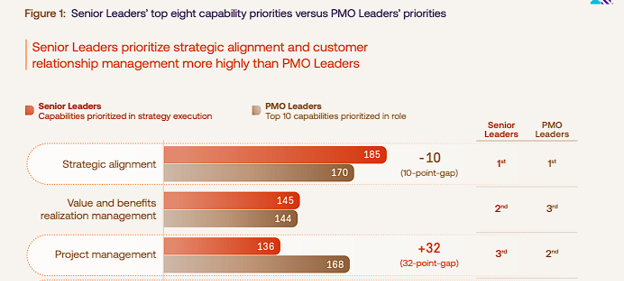
PMI’s latest PMO research shows a 32-point gap between how PMO leaders and senior executives rank project management as a capability. It’s tempting to read that as executives walking away from the discipline. I think the real story is more interesting (and more fixable).
“I don’t want a consultant who’s going to be PMBOK-y about it.”
I’ve lost count of how many prospective clients have said some version of that to me. I’ve written about the sentiment before (it helped prompt an earlier issue, When Did PMO Governance Become a Tax on Momentum?), and every year I expect the adjective to retire.
It never does.
Then, in 2025, PMI (the Project Management Institute) published its PMO Strategic Partners report, and one of the findings was so interesting that I’m surprised it hasn’t gotten more attention: PMO leaders and senior executives sit 32 points apart on how much they prioritize “project management” as a capability.
The easy read is that executives have moved on. I don’t buy it.
The easy read of that gap is that executives are done. They still want projects delivered well; they’ve just stopped believing that formal project management is how you get there.
Executives have sat through enough project reviews to know that a thick binder of process guarantees nothing. They’ve watched all of it run and seen the intended benefits vaporize, or the delivery be late when it could have been proactively corrected, or the budget be blown in a surprise to everybody. After that, “we need more project management” seems almost laughable.
So I don’t think the easy read is entirely wrong. I also don’t think it’s right.
My answer is no: executives haven’t moved past project management, but a lot of them are wary of a version of it that once cost them more than it delivered. That gap reads better as memory than as judgment, and a memory is a very different thing to change than an opinion.
What does PMI’s 32-point gap actually measure?
These are relative preference scores, not percentages. PMI ran PMO leaders and senior leaders (director through C-suite) through a forced-choice exercise: shown sets drawn from 24 capabilities, they picked which mattered more. The scores rank the capabilities against each other; they don’t count how many leaders called any one essential.
Senior leaders put project management third, at 136. The average capability scored 100, so 136 sits well above the middle of the pack. PMO leaders ranked it second, at 168.
Neither group thinks project management is irrelevant. So why care about the gap?
Two reasons.
First, the sample was friendly. Every senior leader in it carries accountability for project delivery, and even they ranked the capability below where PMO leaders did. Survey a broader set of executives (ones a step removed from delivery) and the number almost certainly drops, not climbs.
So 136 is about the friendliest read project management gets from the executive suite. The people most inclined to defend the capability already have.
Second, both groups worked from the same definition: “deliver defined objectives by planning and executing individual projects to deliver positive outcomes and value.”
Read that sentence and you’d expect the two groups to land in nearly the same place. Who argues with delivering objectives, outcomes, and value?
For me, it comes down to one word in that definition: value.
It’s the leaders who doubt that project management practices reliably produce value, or benefits realization, who mark the capability down.
For those leaders, the method is only worth the trouble when it visibly improves the result. Less “implement good project management practices,” more “show me the outcome.”
Benefits tend to show up (or fail to) months after a project closes and the team has scattered. A leader can watch an initiative hit every milestone, clear every sign-off, and still not move the number it was funded to move.
PMO leaders often see a tight link between the project management capability and benefits realization. Senior leaders tend to see a loose one (usually true, not guaranteed). They came by that skepticism honestly.
Why do executives still associate project management with bureaucracy?
I earned my PMP under the fourth edition of the PMBOK Guide (PMI’s A Guide to the Project Management Body of Knowledge). It was a three-inch binder of processes, formulas, inputs, outputs, tools, and artifacts.
The Guide was careful to say it described generally recognized practice, not mandatory practice. Plenty of organizations missed that distinction entirely.
My early consulting years were spent in the aftermath. Over and over, I got called in because someone had stood up a PMO and dutifully implemented every process, tool, and artifact they could find in that book. The executives were exasperated. Results hadn’t improved. Overhead had doubled or tripled.
None of it was malicious, or even careless. People were doing exactly what the moment rewarded: adopt the recognized practice, all of it, and be able to prove you had. The environment prized visible rigor over results, so visible rigor is what it produced.
“The environment prized visible rigor over results, so visible rigor is what it produced.”
Those executives took away a durable lesson: “project management” meant wrapping more machinery around the work without getting more out of it.
Four PMBOK editions later, the profession has largely self-corrected. The current editions lean hard on principles, tailoring, and outcomes, and away from implying a universal set of “thou shalts” for every project everywhere.
Which brings me back to the title. Have executives moved past project management?
No. But they’re running as fast as they can from the version they think they know.
PMI is changing. The discipline is changing. But memory is long.
So how does a PMO fix a reputation problem?
This is a public relations problem before it’s anything else. Good practice has moved on. The story executives carry around it hasn’t.
Often that story was written years ago, under a different PMO, in the era we just walked through. Executives are still reacting to the office that burned them, not the one running today.
The instinct is to close that gap by force: a new name on the door, a new charter to roadshow. It’s understandable. A rename is easy to do and visible to everybody.
But a reputation is difficult to quickly manufacture.
I wrote a whole issue on the rebrand reflex last year (Why Are PMOs Changing Their Name?), so I won’t relitigate it here. The short version is that a new name buys you nothing if the services behind it don’t change.
A new name is not a new reputation
Reputation is earned slowly, and mostly by other people (inside and outside your organization). The field of public relations has spent a century studying how perception actually moves, and a few of its oldest rules are worth borrowing before a PMO commissions one more rebrand.
There’s a line that’s been around PR forever: advertising is what you say about yourself, and reputation is what everyone else says about you once you’ve left the room.
A rename is advertising. It’s the office standing up and announcing its own worth, which is the weakest kind of persuasion there is, because everyone knows you paid for the billboard.
A name change is worth making when there’s been real, substantive change to the services behind it and the new name helps people understand how to work with you. Short of that, it’s lipstick on a pig.
Why does correcting the record backfire?
Even sharp PMO leaders make the same predictable move: they try to correct the record. They sit an executive down and say, more or less, “we’re not the bureaucratic, box-ticking PMO you’re picturing.”
PR people will tell you that backfires. It’s the classic “Don’t think of a pink elephant” conundrum. When someone tells you not to think of something, you immediately bring it to mind. Say “we’re not bureaucratic,” and the word your executive walks away holding is bureaucratic. You’ve spent your airtime reinforcing the exact association you wanted to break.
What works is the opposite. Stop describing yourself and hand people a different experience to talk about. Pick one thing an executive actually worries about (a status report that says nothing, a project that’s been “almost done” for three quarters). Solve it where they can see it. Then do it again.
That’s earned reputation. It’s slower than a rebrand and far more durable, because other people are doing your talking for you. They’re telling their peers what it’s like to work with your PMO now, based on what they’ve actually experienced, not the baggage they walked in with.
“Your job is to be the uncomfortable counterpoint to a broken story.”
I say a version of this to my coaching clients all the time, usually when they’re worn down by having to dismantle a perception that isn’t fair: your job is to be the uncomfortable counterpoint to a broken story. Keep at it, and eventually people have to reconcile what they believe with what they keep seeing.
You can’t argue a memory away.
The gap PMI measured isn’t executives rejecting project management. It’s executives remembering what project management has cost them. You don’t correct a memory like that with a new label, better talking points, or one more pass at implementing everything you think the PMBOK Guide told you to. You correct it with a different experience, repeated until the old one stops being the reference point.
Do that with enough executives, and the 32-point gap closes on its own. The memory finally has something to argue with.
If You Only Do One Thing
Pick the executive most skeptical of your PMO. Find the one problem they’d be most relieved to see solved (ideally the one they don’t believe you can help with), and go solve exactly that, in a way they can watch happen. Say nothing about your value while you do it. Let them be the one to bring it up.