
PMO leaders have finally agreed that business acumen separates the PMs who protect the investment from the ones who just deliver scope. But nobody seems to know how to interview for it.
Interviewing project managers isn’t easy, but at least it’s straightforward. Technical skills come out when a candidate walks you through past projects. People skills emerge from behavioral questions. But business acumen (a core domain of the profession, and a key driver of success outcomes) is much harder to uncover ahead of time.
I have a theory about why: we spent decades telling project managers the subject matter wasn’t their job (“a good PM can manage any project”), and we hired accordingly. Now the same research says only 18% of project professionals demonstrate high business acumen, everybody wants to hire for it, and nobody is really sure where to start.
I’ve never interviewed a coworker before, but Monica Del Valle is the person I’ve trusted to shape our own hiring process at Persimmon. She’s spent more than twenty years leading large portfolios and programs, and when a client needs project managers who can hold their own with executives, Monica is who I trust to find them.
This interview is our conversation about what it takes to screen for business acumen, what makes it so difficult, and why it’s never been more important.
Here’s our conversation.
What is business acumen, really?
Monica: Well, first you should know that my approach didn’t start from a blank page. Almost fifteen years ago, during my time at a Fortune 500 energy firm, I was working with and administering formal Korn Ferry assessments. Those instruments shaped how I think about competencies to this day, business acumen among them.
The Korn Ferry definition is where I started: business acumen is the ability to read cause-and-effect across business functions and financial performance, and act on it. PMI comes at it from the delivery side: business acumen is the ability to connect the project to the organization’s strategic and financial goals (benefits, ROI, market dynamics) and to move from executing scope to creating value.
My working definition pulls those together: business acumen is the ability to see the project the way the business sees it, and to make trade-offs that serve the enterprise rather than just the plan.
A candidate can say, truthfully, “I ran a $5 million program” without ever having understood why it was funded, what the business really cared about, or how project decisions protected or compromised the business case.
On paper, or in a standard interview, that candidate can easily look identical to the one who understood all three.
So how do you uncover who has business acumen, and who doesn’t?
Monica: Two ways. First, most questions in an interview is behavioral and grounded in their real experience, not hypotheticals. It’s “What did you do and why?” not “What would you do if…”
I’m looking for what someone actually did on a real project and why, and I’m looking for nuanced business and stakeholder thinking. Even if the action didn’t get the desired results, a well-articulated explanation about why can reveal a lot about a person’s ability to see their project from a business lens.
Second, while our interviews are behavioral, we also ask candidates to write a response to a complex case study. We give them 48 hours and we do allow them to use AI to assist their response. The key: They are responsible for everything on the page, including the depth of analysis. They also will be asked about their responses in the interview.
Here’s why we do both:
Interviews favor candidates who can think and speak at the same time. That’s a valuable skill, but it’s not the only way to be an exceptional project leader. We also need people who, given some time to strategize, can come back with an amazing, well-considered plan. Our interview + scenario strategy gives both types of person a way to show us what they can do.
When you’re interviewing, or reading a person’s case study response, what are you looking for?
Monica: I walk every candidate through the same sequence. I think of it as three rings.
- The first ring is the candidate themselves: can they read their own impact on other people?
- The second ring is the business: what is the project for, and does the PM understand the factors that would lead to success or failure of the business case?
- The third ring comes back in close: the people around the project, and how well the candidate can think like them.
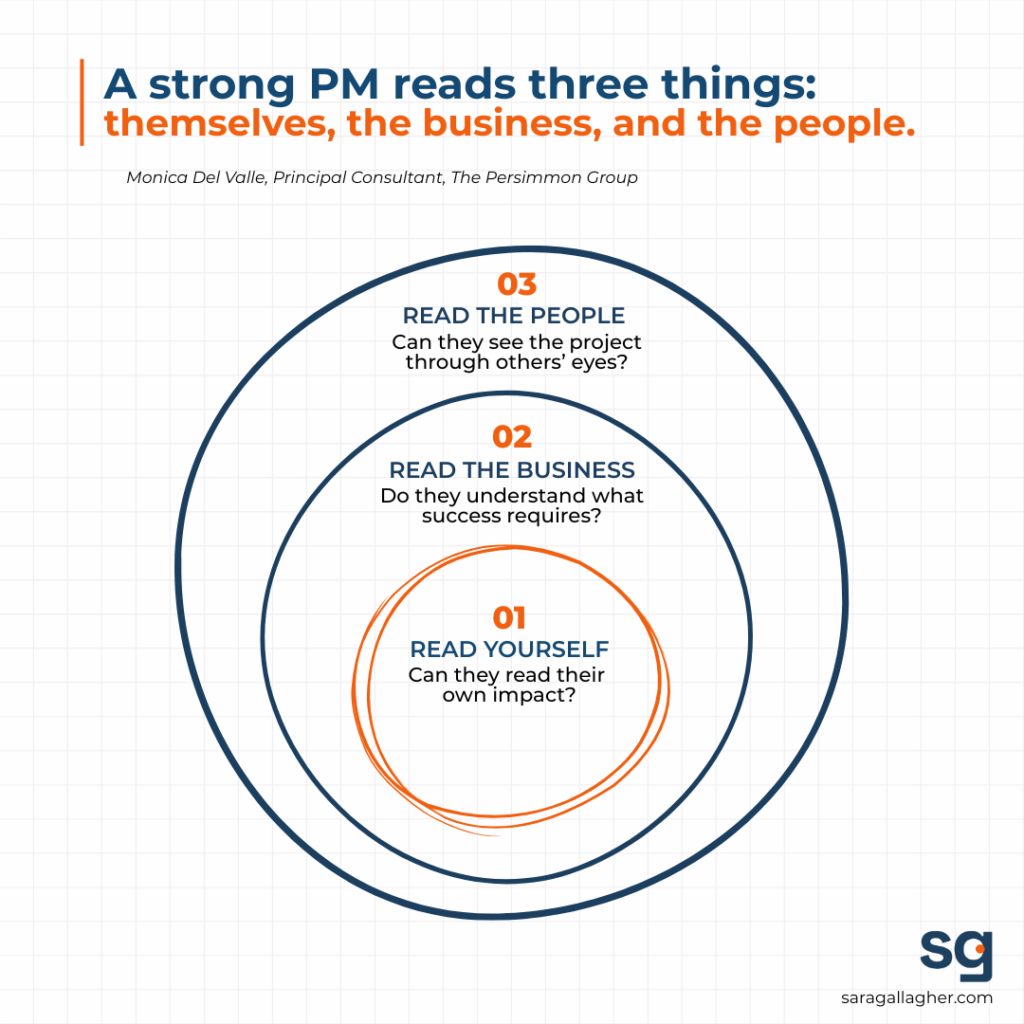 I start with the first ring because the whole job is reading people, and you can’t read people if you can’t read yourself. There’s a stat I love. Most of us are convinced we’re self-aware, but research puts the real number around 10 to 15% (and the odds get worse the more senior you are).
So I open with something like: “How would your last sponsor describe the value you added? Now, how would your delivery team describe it differently?” A strong candidate gives me two different answers, because those two groups want different things from a PM.
My red flag is the candidate who claims everyone loved them. Nobody comes across the same way to everyone, and a PM who thinks they do can’t read a room. Reading rooms is most of the job.
Has this candidate ever delivered for a private-equity-backed company? A public one? A nonprofit? Why does ownership change the job?
Monica: Because how an organization is run changes sharply with who owns it, and a PM who has only ever worked one model will usually run the same playbook everywhere. That’s how they get burned.
At a PE-backed company driving toward a two-year exit, the sponsor hears “we’re still discovering scope” as a threat to the investment thesis, and responds accordingly. A public company managing quarterly guidance hears risk differently than a family-owned firm does. Nonprofits and government agencies have their own logic entirely, from the funding rhythm to what counts as success.
So I’ll ask: “How would you handle a stalled critical dependency differently at a PE-backed company chasing an exit versus a public company managing quarterly guidance?” If a candidate has never once thought about it, that tells me plenty.
You split stakeholders into two lists: people who care whether the thing gets built, and people who care whether it matters. What’s the reason it should be two lists?
Monica: A PM who runs one list over-serves the loud voices (typically the ones closest to execution) and under-serves the people closest to the business rationale.
One of my favorite interview questions: “Who could have killed your last project without ever attending a status meeting, and how did you manage them?” A candidate with real acumen names someone specific (a division controller, a plant manager, a chief of staff) and tells me how they worked out what that person cared about. A candidate without it lists the project team, the sponsor, and the steering committee and stops.
Every PM candidate on earth says communication is their strength. How do you test whether that’s actually true?
Monica: “Give me an example where you deliberately communicated the same project fact three different ways to three stakeholders. What did you know about each person that drove the difference?”
There’s no rehearsed answer to that one. Either they’ve done it or they haven’t. Because a PM with real business acumen doesn’t send the same status email to everyone: the CFO wants the number, the sponsor wants the risk, and the operations lead wants to know what stops working the day this thing goes live. The PM who understood the business first knows all of that without being told.
Doesn’t your method assume the interviewer has high business acumen too? Statistically, most won’t. Doesn’t that break the whole thing?
Monica: I know it’s inconvenient, and I hold the line anyway. The questions are only as good as the person listening to the answers. It takes real acumen to listen past a polished answer and judge whether there’s substance behind it; in less-practiced hands, the same questions will reward the articulate and overlook the able.
That’s why the people who most urgently need business acumen, if they don’t already have it, are PMO leaders. A lot of leaders don’t make this shift—they continue to learn new ways of working (classic PM skills or trends), but stop learning about their own business. That has ripple effects all the way down the line.
If business acumen drives project results, why doesn’t anyone interview for it?
Monica: Because it’s hard, and “let’s have them meet the team” is easy. Doing it for real takes structure, behavioral questions, a deliberate sequence, and an interviewer who can hear the difference between articulate and able. But it’s the only way I’ve found to spot the 18%, because on paper, they don’t look any different.
If You Only Do One Thing
I loved this conversation with Monica, and I hope you did too. If I were you, I’d steal one question from Monica for your next PM interview: “Who could have killed your last project without ever attending a status meeting, and how did you manage them?” is a great one to start with. Then, listen for whether the answer is about the business or about the project plan.
Your Turn
What’s the one interview question that has told you the most about a PM candidate? I’d genuinely like to know — reach out here or find me on LinkedIn. I’m always collecting.