

At their best, steering committees look at a decision from every angle and make it sharper. At their worst, they offer safety in numbers: if the call goes wrong, no single person has to own it. What if AI could do both, improving the decision while lowering the political cost of getting it wrong?
Steering committees exist so the people who’ll live with a big decision get to look at it first: finance, operations, IT, the business. Each of them is supposed to bring a different perspective to the table, and the decision is supposed to come out better for it.
That isn’t always how it goes. Often, the decision gets settled in hallway conversations before the meeting even starts. Concerns get shrunk to a line or two on a portfolio status report. And when it’s time to decide, siding with the majority is the safest place to stand, because a decision eight people made is one no single person has to answer for.
So try a thought experiment. What if AI got one of the seats at that table?
I’m picturing more than AI taking notes or tidying up the status deck. I mean a seat with an opinion of its own.
It reads the same materials as everyone else. It points out the contradictions, the missing evidence, and the assumptions nobody’s challenging. And its view goes on the record alongside the humans’.
The case for it is simple: it has no career to protect. It doesn’t report to the sponsor, and it won’t lie awake wondering whether it said too much. So it can say the thing half the committee is thinking and nobody wants to say out loud. (Which, honestly, is a big part of why companies hire consultants.)
Then there’s the homework. AI will read every page, remember every past decision and the assumptions behind it, and it’s never rushing off to the next meeting. Some committees I know are so short on time that they routinely push PMs to boil the decisions they need down to a few sentences (which they still skim instead of reading).
So the real decision gets made in the loose discussion around those few sentences. And a discussion where nobody has done the reading goes wherever the loudest person in the room wants it to go.
An AI seat sounds like a gimmick. But the longer I think about it, the more seriously I take it, because it could fix some of what’s broken about steering committees.
Or, it could make everything a lot worse.
Is AI as rational as we imagine?
In October 2026, Charter’s AI Pulse found that 32.8% of executives who use AI at work trust it more than they trust their own judgment.
My guess is that’s because we picture AI as rational, backed by more information than any of us could learn in a lifetime. We believe it reasons from first principles, and that those first principles are objective. Hand it the facts, and it argues its way to the truth.
That belief is all over LinkedIn right now. People who’ve gone all in on AI are teaching others to build their own AI “board of directors”: one agent plays the CFO, another the CMO, another the COO, each ready to weigh in on your next big decision. No human experts needed.
It sounds great in theory. In practice, the idea runs into two problems.
First, AI isn’t as objective as it sounds. Researchers writing in HBR in March (2026) asked seven leading AI models to take sides on classic strategy trade-offs. One was whether to compete on price, or to hold firm on pricing and compete on the value or quality of the product instead. On most of those trade-offs, nearly every model picked the same fashionable side (here, standing out by refusing to compete on price).
Across thousands of deeper tests on ChatGPT, even detailed descriptions of the company shifted its answers by only about 11%. The researchers call this “trendslop”: the tendency to give generic advice even after you’ve supplied the specifics that make your situation unusual.
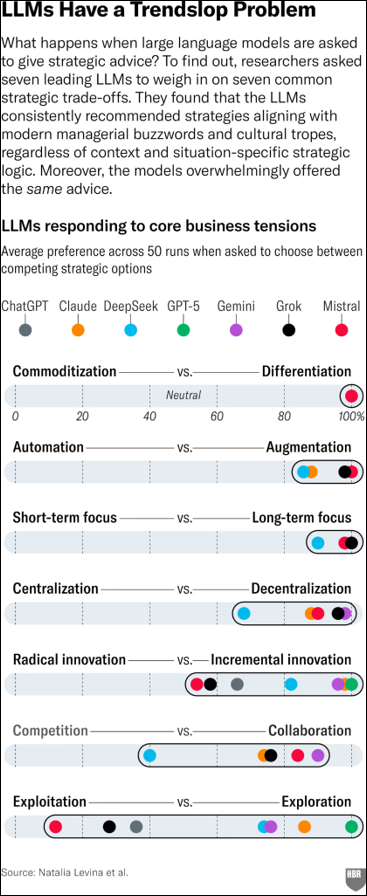
Put another way, AI is less rational and less objective than we assume, and it often picks the answer that sounds good over the one that fits. The study only tested AI’s positions on strategy questions (not other business domains), but I’d expect the same thing to happen with a steering committee’s trade-offs. (For example, AI has never once told me to choose speed over caution, even when the benefits of speed outweighed the odds of something going wrong.)
Second, AI can be talked out of its first position. Easily. In the same tests, just flipping the order of the options cut the fashionable answer by 19%. And in my own work, a round or two of “yeah, but” will often talk it out of a position altogether.
(Classic AI catch-phrase: “You’re right, and it makes my position weaker than I claimed.”)
A human who argues from fashion, or caves under pressure, is easy to spot. An AI doing the same thing shows up looking sharp, buttoned-up, and objective. That’s irrationality that passes for rationality, and it’s what could make AI dangerous on a steering committee.
Hiding behind an answer like that is exactly the safety in numbers we were trying to get rid of.
AI’s limitations are disappearing fast.
An AI “steering committee member” may be a mixed bag today, but don’t count it out for tomorrow. AI does an awful lot well now that it couldn’t do just six months ago.
Here’s a practical example. Yesterday, while I was in line at Starbucks, my personal agent warned me, unprompted, about a significant travel issue on an upcoming trip (one that would have cost me money), suggested two dates for my dentist appointment, recommended a piano tuner, and offered to register my daughter for a babysitting class.
On the work side, when I get ready to write one of these newsletters, AI’s “red team” of my starting position gets stronger every month. That hints at how much better AI pushback could get with another year of development.
I think that as the models get more capable, the upside of bringing AI into decision-making could very well start to outweigh the risks.
Three models (might) be worth experimenting with today
AI may not be ready to join our steering committees yet, but that doesn’t mean PMOs should wait to experiment with AI’s help on decisions. Experimenting early can strengthen recommendations before they ever reach the committee. And experimenting now gets PMs ready for a future where AI routinely argues against their recommendations, or makes its own call before the committee meets. Here are three models to try:
The red team.
AI argues, in writing, against the position on the table (usually the PM’s recommendation), the way a dissenting opinion works in court. The PM could use that dissent as-is to refine the recommendation, or, even better, hand it to a peer PM to review and suggest improvements.
Human dissenters often pay for speaking up with strained working relationships. AI can dissent without straining any. That written dissent (paired with human taste and judgment) is worth bringing in for a fairly small investment of time.
The counter-decision.
AI gets the same data the PM has in front of them and makes its own call, with evidence and a list of what, if true, would undercut its argument. The prompt has to force it to choose one option, because when the researchers let ChatGPT off the hook, it “frequently recommended doing both.”
If AI’s answers follow fashion, it’s fair to ask why it gets a vote at all. My answer is to keep its decision sealed: the PM asks for it only after forming a recommendation of their own. Order matters. Don’t let your own position get anchored to the AI’s “rational” decision-making.
The shadow committee.
This one is wild, but I’ve done a version of it in my own work, and it was surprisingly helpful in getting ready for a tough meeting. It takes some light experience building agents, plus deep knowledge of your (human) stakeholders. Here’s how it works.
The PM builds an agent version of each steering committee member, with that member’s input, set up to care about what that member actually cares about. That’s what sets it apart from the AI board of directors, which hands you a stock-image CFO and assumes it’s as good as your real one.
The agents receive the PM’s report and instructions to argue with one another until they reach the best answer. Alongside that answer, the “shadow committee” has to surface the positions that came up and explain why they weren’t chosen in the end.
The result is a simulation of what would happen if every member said what they really thought, without anyone putting their standing in the organization at risk.
The obvious risk is that the agents converge on the fashionable answer anyway. That’s why it matters so much to tell the agents to show their receipts: the positions they considered, the positions they rejected, and the reason(s) for each rejection.
If You Only Do One Thing
Start with the red team model. Ask AI for an adversarial review (use that exact phrase in your prompt) of a recommendation your team is about to make. Talk through the results openly with your team, including whether the review calls for changes to the position, before the recommendation goes to the steering committee. (Then drop me a note and tell me how it went.)