

Lately, I can’t walk out of a discovery session without hearing some version of this:
We’re getting pummeled by change. Every time we find our footing, something else shifts.
I recognize the pain. Our team feels it too.
But over the last few years, my consulting calendar has been wall-to-wall with PMO leaders preaching agility while their teams bolt workflows to the floor.
In other words, the gap between what leaders want (speed, agility, edge) and what their PMOs design (governance, sub-steps, another RACI) is…wide.
It’s not just me who notices this.
A recent Deloitte study (2025 Human Capital Trends) captured the problem perfectly:
- 75% of workers want more stability
- 85% of executives say their orgs need to create more agile ways of working
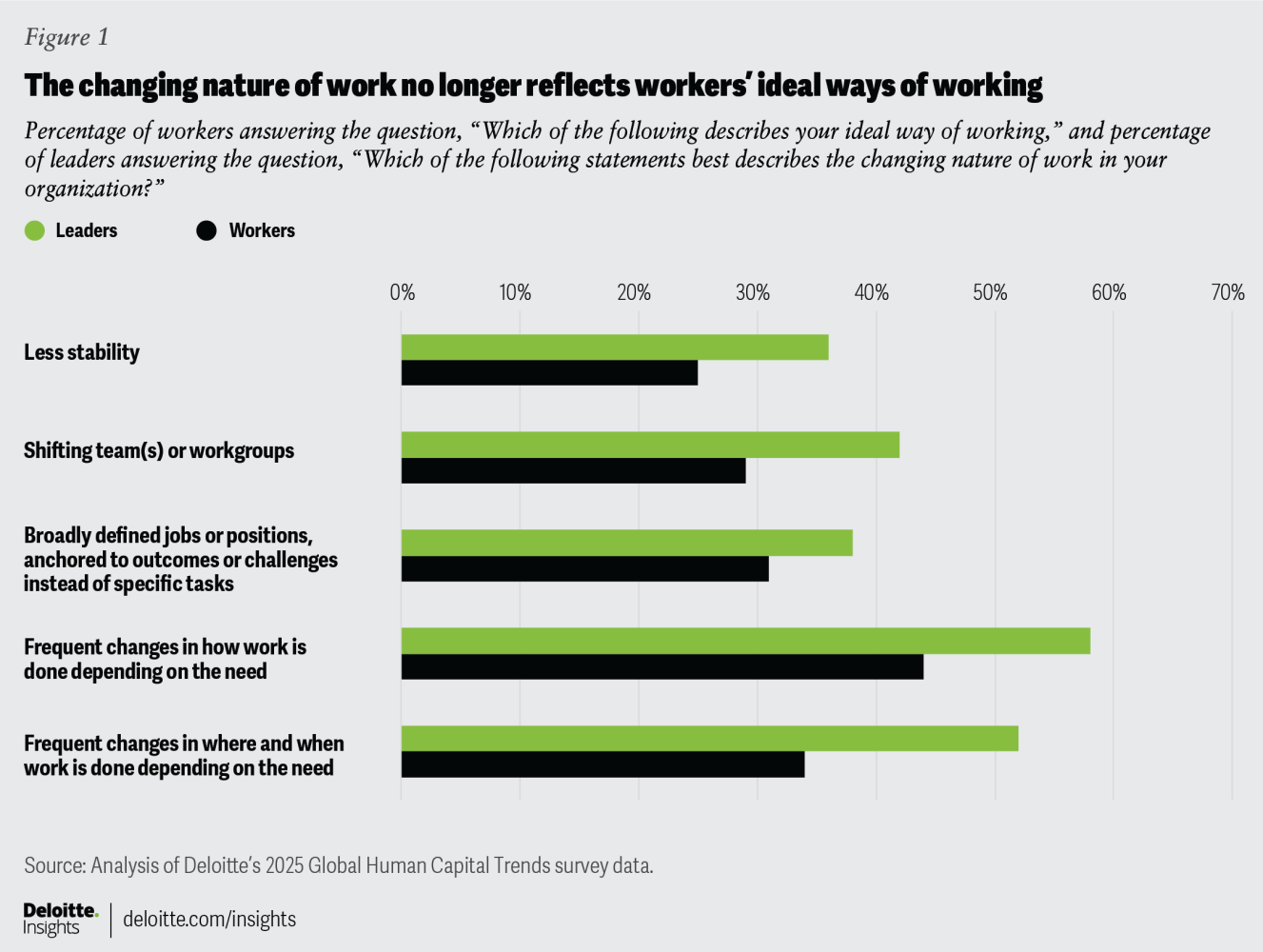
No wonder I’m getting phone calls. One side is shouting “Hold still!” while the other yells “Move faster!” Often, I find myself the referee.
Deloitte’s advice is to chase something called stagility. (Clever). As implied in the term, leaders should be chasing a balance of providing the stability employees crave with the agility needed to shift quickly with the market.
Tidy solution, but based on my experience, I have to wonder if that’s realistic. And Deloitte’s own findings validate my suspicion.
Take a look at this…
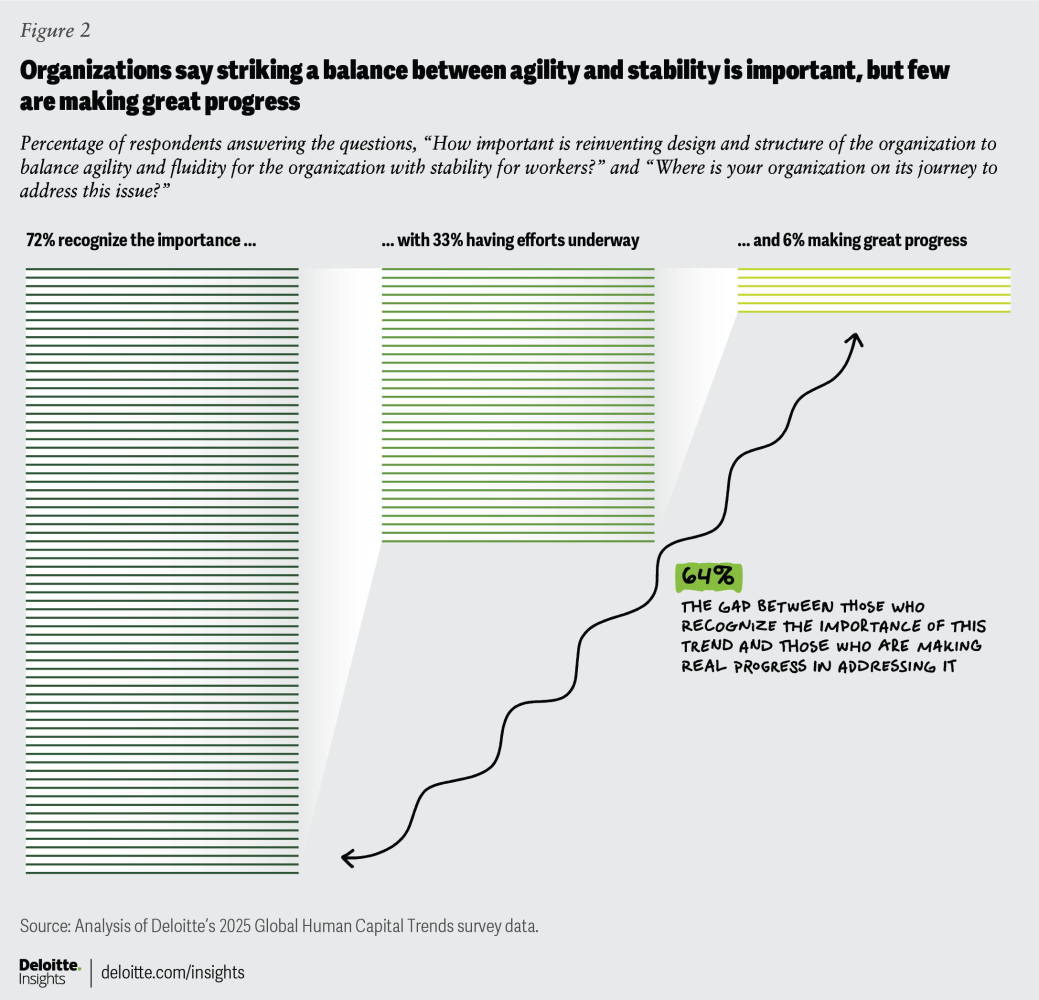
72% of respondents believe that there is a balance between agility for the organization and stability for workers. Yet only 6% believe they are making good progress.
Here’s my 2-part theory…
- Balancing agility and stability won’t lead to breakthroughs because it’s based on a false premise.
- We’ll get a lot more traction if we let go of the stability/disruption paradigm altogether.
In other words, we have to stop viewing work as periods of stability punctuated by “disruption.” Instead, we should view change as the water we swim in, and “stability” as an occasional breath of fresh air.
What does this change?
Here’s my 2-part theory…
- Balancing agility and stability won’t lead to breakthroughs because it’s based on a false premise.
- We’ll get a lot more traction if we let go of the stability/disruption paradigm altogether.
In other words, we have to stop viewing work as periods of stability punctuated by “disruption.” Instead, we should view change as the water we swim in, and “stability” as an occasional breath of fresh air.
What does this change?
Last Saturday, I poured coffee, opened a novel, and let my kids loose in the backyard. I pictured twenty quiet pages under a breezy sky.
Reality:
- Mom, look at this bubble!
- Mom, watch this!
- Mom, I made you a leaf bouquet!
I’d gone into the experience expecting stability. And I was brutally disappointed. If I’d expected “disruption” as the default, I would have come up with this genius idea sooner:
Hey guys, let’s play a game. For every page I read without interruption, you get to stay that many minutes longer outside.
What’s the lesson?
When we optimize for an imaginary future, we resent the real one. And that means we keep chasing hope instead of formulating a plan. As a colleague used to say: “Hope is not a plan.”
Airline pilots get this…
Every commercial flight files a flight plan—a detailed route with waypoints, altitudes, fuel calcs, and weather allowances. But pilots are also trained to reroute around pop-up storms, and air-traffic control holds slot capacity for exactly that. In other words:
Pilots know the plan is just a useful lie.
Their systems and processes are defined, but fundamentally agile-by-design. The goal is not a frictionless flight. In fact, the goal is not a goal at all. It’s an outcome.
What agile PMOs really look like
Hint: the defining feature of an agile PMO isn’t adopting an agile framework. It’s not about sprints or retros or demos (though those can help.) An agile PMO prioritizes these four capabilities:
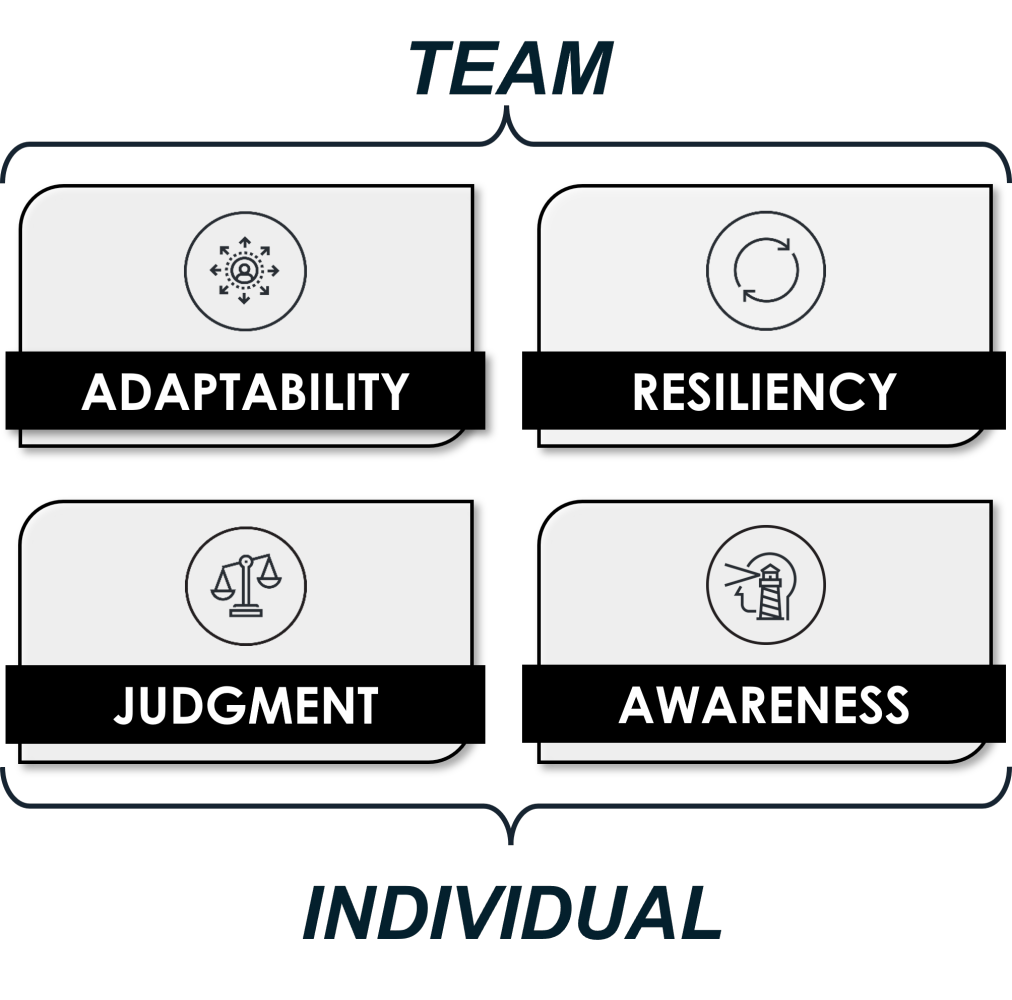
Roughly defined:
- Adaptability. Ability to adjust course quickly in ambiguous situations
- Resiliency. Sustaining energy and performance when the ride gets bumpy
- Awareness. Spotting change early, inside and outside the system.
- Judgment. Deciding well when the rulebook runs out of pages.
These aren’t personality traits; they’re muscles we can build.
Seven Keys to Moving at the Speed of Change
Here’s what I’ve learned, and what I coach PMOs to do:
- Stop Expecting Stability. You can define the happy path, but don’t expect it to happen. Realistic expectations lead to fewer disappointments and frustrations—and better plans.
- Sharpen the Signal. Coach your team to develop “helicopter mind.” In other words, train your team to identify on the spot, in specific terms what’s changed? (high elevation) and what’s next? (low elevation).
- Prioritize Outcomes Over Directions. Define the desired outcome. Also define the acceptable outcomes. Support your team’s decision-making when they can draw a straight line between what they did and the outcome they were seeking to achieve…even when it didn’t work.
- Predefine the 24-Hour Response Plan. Just like a fire drill, decide in advance how your team will consistently respond quickly to a change in plans, circumstances, or goals. It doesn’t have to be complicated. Just four or five steps your team will take every time to get early momentum. Example: Identify who is impacted. Define acceptable outcomes. Establish a communications channel. Specify the next checkpoint.
- Clear the Gutters. Use rare moments of calm to identify and remove the friction that will become tomorrow’s bottleneck. Never waste a dull moment.
- Learn Each Other’s Jobs. Every member of your team should understand the upstream, downstream, and cross-stream impacts of their work. They should be able to say what other people need to be successful.
- Become a Storyteller. Change has an emotional component; develop the vulnerability and skill to share your experience. What moments of disruption have you survived? How did you survive it? What did you do to thrive?
Presentations tell people what’s changing. Context explain why it matters. Stories show how to survive it.