

A few weeks ago, a friend sent me a screenshot of a LinkedIn post with a comment section that was blowing up. The post argued that a project manager’s job is not to deliver value, only the scope, on time and within budget.
Do PMs Deliver Scope? Or Value? (A Profession On Trial)
A few weeks ago, a friend sent me a screenshot of a LinkedIn post with a comment section that was blowing up. The post argued that a project manager’s job is not to deliver value—only the scope, on time and within budget.
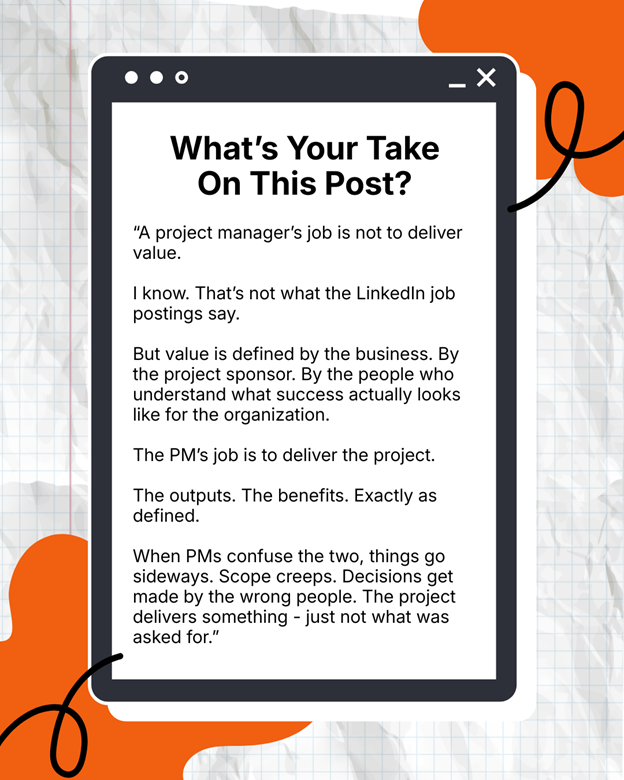
I’ll admit my eye-roll was involuntary. I thought we’d put this debate to bed.
But reading the comments, it seems a growing number of people want to relitigate the question. Which is a problem, because if it’s true that AI will eliminate 80% of today’s project management tasks by 2030, our profession has very little time to figure this out.
Why Do Some PMs Say “Just Deliver the Project?”
I’d like to give this position the hearing it deserves, as best I can. Because the argument is stronger than my eye-roll gave it credit for.
Start with the comments. The post had plenty of supporters, and their reasons were specific and credible.
- Several pointed out that there’s no harder PM to work for than one who used to be a subject matter expert. The person who can’t let go of the content, second-guesses the technical team, and uses “adding value” as cover for slowing the project down while they relitigate decisions that have already been made.
- If you’re in a highly regulated environment—pharmaceuticals, defense, construction—scope deviation can have contractual or regulatory consequences. Somebody has to be the person who says, “That’s not what we agreed to build.” Scope discipline is core to the value proposition.
- When PMs deliver with total discipline—clean baselines, consistent reporting, minimal mid-course adjustment—leadership gets something valuable: the ability to see across the portfolio what’s working and what isn’t. Clean lab conditions. When every PM is making value judgments and adjusting baselines on the fly, that enterprise-level visibility gets confusing fast.
So the steelman version of this argument isn’t just “stay in your lane.” It’s something more like:
Someone has to protect the baseline. Someone has to guard the investment as it was defined. And if the PM is busy redefining success, who’s making sure the project actually ships?
These are all solid points, and we’d be silly to ignore them. In fact, sitting with them a little longer, I’ve come to realize that my “answer” to this particular issue is more nuanced than I thought. Here’s why.
What’s Changed: We Finally Have a Clear Definition of Project Success
For a long time, we’ve danced around this issue unproductively—mostly because we all brought different definitions of “value” to the debate.
But recently, the Project Management Institute (PMI) has taken some solid steps to establish common terminology, including these two important definitions:
- Value: The excess of monetary and nonmonetary benefits over the investment gained from achieving the goals of a project.(PMBOK Guide 8)
- Project Success: Projects are successful when they deliver value worth the effort and expense. (PMI Report, 2024, “Maximizing Project Success“)
Why does this matter? Because if we take these definitions as a starting place, then for me, it clarifies a few important things:
- Project Managers don’t (and can’t) own whether the project was a good bet to make. Bad bets, uncontrollable risks, and shifting business needs can make projects “not worth the effort and expense” in the blink of an eye. In this, it’s true that PMs can’t “own” value. All sides of this debate likely agree with this statement.
- Project Managers who are primarily coordinative—who focus solely on the logistics, communication, and relationships needed to deliver a defined scope—are only valuable to an organization if three things are also true:
- A – The PM leads projects whose business cases hinge almost entirely on the predictable delivery of a defined scope within a planned budget and schedule.
- B – The PM can prove that the projects they lead have superior scope, schedule, and budget performance.
- C – The PM’s coordinative work can’t be done better with AI.
But here’s the key. Even if all three things are true, these PMs are still focused on delivering value. It’s just happening by accident…because the business case is predicated solely on baseline adherence, and traditional “just deliver” attitudes are also.
- The Project Managers’ organizations will need, between now and 2030, those who deeply understand complex business cases… and how to protect them.
If Gartner is right, this is the PM most likely to survive and thrive over the coming decade.
That’s because, in my view, project management will become much less about coordination and analysis, and more about decision-making.
If AI is feeding us data, analysis, options, flags…someone has to make sense of that. Someone has to reconcile that with reality on the ground. Someone has to weigh AI’s data and probabilities against evolving business realities, stakeholder concerns, and strategic shifts. And someone will have to take accountability for AI’s output.
All that sense-making is in the service of one thing:
making decisions that maximize value and minimize risk.
That’s not possible without some serious business acumen and an attitude that says: “I want to produce what’s most valuable,” rather than “I want to produce what this piece of paper says.”
What Business Case Protection Looks Like in Practice: A Tale of Two Sponsors
Here’s a simple way to see what’s at stake. I use this exercise in workshops.
Imagine a project to replace emergency generator systems at two data center sites. Same scope, same budget, same charter. Two executive sponsors, each overseeing one geography.
Sponsor A: Leslie
- Leslie runs the West Division. She wants a forward-thinking, efficient, future-model project. Her lens is innovation and reputation.
- Leslie’s Definition of success: “Leadership points to this project as the model for future infrastructure upgrades—completed without disruption and enhanced by predictive maintenance tools.”
Sponsor B: Calvin
- Calvin runs the East Division. He’s focused on risk reduction, regulatory compliance, and full audit readiness. His success lens is “no surprises.”
- Calvin’s Definition of success: “All critical emergency power risks identified in the recent audit have been eliminated—and no new ones have been introduced.”
Same project. Same scope. Two completely different versions of what it means to get this right.
Now: Which sponsor is the project manager executing for?
Because the answer shapes how they frame change requests, what risks they escalate, what “done” looks like, the questions they ask during scoping, how they present options and recommendations to leadership, and how they manage the stakeholder landscape around the project.
A PM who’s “just delivering the project” treats Leslie and Calvin the same. A PM who understands why the project exists manages them completely differently…and gets a better result for both.
Should a PM Own Value Delivery? Yes…If We Want the Position to Survive
If it’s not already clear, I agree with Gartner. Most of what we today call “project management” is about to go away. Maybe in 2030, maybe 2035.
And I couldn’t be more excited.
I’ve spent over fifteen years in PMO consulting, project management training, and coaching. Whenever I’ve talked about proactively managing risk, the refrain has been the same: with what time?
Well, we’re about to have a lot of it.
The PMs who thrive will know exactly what to do with the breathing room: they’ll shift focus from protecting baselines to protecting the business case. That includes protecting the baselines—the “just deliver” camp is right about that. But it doesn’t stop there.
Protecting the business case also means knowing why the project exists and what the sponsor is trying to achieve. And recognizing when something shifts that could put the investment at risk. It means being close enough to the work and the strategy to guide the project toward generating value worth the effort and expense.
Here’s How PMOs Should Hire (or Develop) Right Now
Coordination, logistics, communication…all still important. Technical skills, too. But the more time goes by, the water those hold. That’s why for our team at Persimmon, our two-part measuring stick is simple:
- Do your executive sponsor(s) trust you to guide the project toward value that’s worth the effort and expense?
- Do your executive sponsor(s) believe this project is less risky to do because you’re leading it?
These questions guide what to train, what to coach, what to expand, how to hire, and how to prepare our team for what’s coming. They survive fluctuations in available tools, automations, and AI initiatives. They tell you (and us) exactly where to flex and where to conserve our energy.
Let’s take these one at a time:
Question 1: Do your executive sponsor(s) trust you to guide the project toward value that’s worth the effort and expense?
That means the PM has to know why their project exists, what the organization wants to achieve (tangible and intangible benefits), and what risks, trends, and events would put value at risk.
Rather than coordinating backward-looking status reports, these PMs are using AI to track and analyze leading indicators of performance. They’re thinking through scenarios holistically (not just in terms of impact to baselines). They have enough subject-matter expertise to effectively connect the dots, connect teams, flag risks, and suggest solutions.
Executives trust their decision recommendations precisely because their attitude isn’t: “Business acumen is above my pay grade.”
Question 2: Does your sponsor (and organization) believe the project is less risky to do because you’re leading it?
That doesn’t mean the PM is responsible for whether the project was a good bet. And it doesn’t mean they should be held accountable for unpreventable risks—especially on projects with a high risk profile, where some things will go wrong no matter who’s at the helm. But it does mean the PM should make it their business to understand the investment well enough to protect it from preventable harm.
It means recognizing when something shifts that could put the investment at risk. It means being close enough to the work and the strategy to guide the project toward generating value worth the effort and expense, leveraging opportunities (“positive risk”) and navigating hazards that others (including AI) don’t see.
If You Only Do One Thing
If you’re a PMO leader, do everything you can to help PMs take part in the business case build-out. (At minimum, get them access to it retroactively or at the start of the project). PMs who help shape the business case are better equipped to protect it during execution. PMI’s own 2025
PMI’s 2025 Pulse of the Profession report bears this out: PMs with high business acumen don’t just outperform on business value. They also show better adherence to budget and schedule baselines.
Business acumen makes you better at the fundamentals, not worse.
And yet fewer than 18% of project professionals can be considered highly proficient in business acumen.
Let’s change that.
Save and Share!
If this changed how you think about estimating, save it (or send it to a coworker). And if you have a “big dumb question” worth tackling in a future issue, DM me your thoughts or send them here! The best issues come from real conversation.