

I didn’t plan to write this newsletter.
I was halfway through writing about something else when Microsoft Teams threw me a curveball: a new feature that shows who talked when—and for how long—in a meeting. It looks like a colorful barcode. The thicker the line, the more someone dominated the airtime. The thinner it gets, the quieter they are. It looks like this:
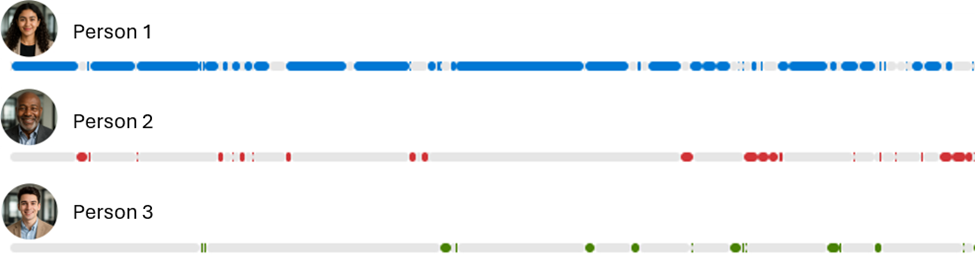
The meeting I saw had five of us in the room. I left feeling energized. Then I saw the graph. I had spoken for nearly 40% of the time. Which got me wondering: Is this normal?
How much talking is too much? What’s helpful to say, and what’s stifling? And given the answers probably depended on the meeting type, my head was swirling—how was I supposed to use this information when the answers changed from meeting to meeting?
Obviously, I had to unpack it.
Talking More Feels Natural When You’re Responsible
First, let’s get this out of the way. Our personality has a potentially significant impact on how much leaders talk. So does neurodiversity. For example, I have ADHD, which means it’s hard for me to hold on to a thought for very long. I worry that if I don’t say it now, I’ll forget it. That’s one reason why, even though I’m an introvert, I tend to talk a lot in meetings.
But even accounting for personality differences, I’ve noticed that leaders tend to outspeak others.
I think one reason is that when you’re responsible for results, you feel a certain weight. It can feel risky to stay quiet. I find myself thinking things like:
- “Uh oh…they’re landing on an idea, but they’re forgetting (or don’t know) X, Y, or Z.”
- “They’re only dealing with one part of the issue. I should state the problem again.”
- “The team is going in circles. I need to step in and summarize the options.”
So I talk. A lot. Not because I’m trying to dominate, but because I feel responsible.
Talking feels like a form of care.
And when I’m talking, it doesn’t feel like a lot. It feels like steering. Explaining. Moving the work forward. But I also know: the person across from me might be hearing something else entirely.
The Curse of a Quiet Room
I once coached a senior leader who couldn’t understand why his leadership team seemed disengaged. He ran weekly meetings with clear agendas. Asked for feedback. Emphasized transparency. But he also filled 90% of the airtime.
But it wasn’t even the amount of talking that wore people down—it was the rhythm. His voice left no space. When he asked questions, he often answered them himself. When he paused, it was just long enough for someone to inhale before he jumped back in.
People didn’t speak because there was no invitation to. His team wasn’t checked out; they were waiting to be let in. And that created a big problem:
This guy was brilliant, but he had been an executive too long.
He simply didn’t understand what was happening on the front line, and without the ability to listen, he was frequently solving the wrong problems in the wrong ways.
Leaders who talk too much don’t just block inclusion; they lose critical insights.
We lose the chance to hear things we don’t know, to surface risks early, to build buy-in before decisions are made. Dominating airtime doesn’t just silence voices—it shrinks the collective brainpower in the room.
So imagine my dismay when I realized…I might be doing the same thing.
Will Microsoft’s Metrics Help?
I’ll be honest. The Teams graph feels invasive. But the more I sit with it, the more I see its potential. It doesn’t judge. It just shows. It offers data, leaving the interpretation and reflection to you.
After most meetings, I find myself staring at that graphic—quietly recalibrating what I thought just happened:
- What kind of talking should I have done in that meeting? And how much?
- How often were people responding back to me, instead of to each other?
- Who never spoke unless prompted?
- Who carried the emotional labor of translating ideas for others?
In the past, these were questions I didn’t want to think about. Now, thanks to that stupid graph, I don’t have a choice. (LOL).
Seeing It Is One Thing…
Actually changing is another.
In my career, I’ve found that self-awareness alone doesn’t naturally lead to different behavior. You have do something—put real structures in place—to change how you show up. So here’s what I’ve been doing:
1. I review the graph. Every time.
Before I look at the graph, I imagine my ideal share of airtime. I also think about the type of talking I did in the meeting, and how it felt. Was I intervening because I was stressed? Worried? Distrustful? Excited? Then (and only then) I check the data and jot down what I learn.
2. I’ve started the “three comment rule.”
When I feel the urge to jump in, I try to wait for three more comments.
- If my point is still needed, I speak up.
- If not, I let the conversation run.
3. I’m using some of my airtime to issue invitations.
To have an effective meeting, it’s not just the over-participators that need to shift their behavior. It’s also under-participators. But sometimes, quieter folks need an invitation—and I’ve found that the invite is best when it includes a specific prompt.
Rather than, “Sandeep, anything to add?” I might say, “Sandeep, do you see any production risks on your side?” This gives quiet folks clear permission to speak, and a prompt to make participating a little bit easier.