

Some words work so hard they lose their meaning. Disruption is one of them.
Early in my career, I was in charge of my employer’s application to a prestigious quality award. It was a year of work—not just the application itself, but implementing the practices that would lead to winning it.
Just three weeks before the evaluators were scheduled to come on site (and after the application had already been submitted), a new CEO was announced. He started on Monday. Within two weeks, he’d made 10+ critical changes to the way we operated, invalidating large sections of what we’d written.
We didn’t get the award.
Today, we might call a CEO change “disruption.” But looking back, my career has been full of these.
- Org restructures.
- Leadership changes.
- New projects out of nowhere.
- Old projects were canceled without ceremony.
In fact, as I think back over the past 20 or so years, I can’t remember a single year that didn’t have at least five significant “disruptions” that either invalidated work, created rework, required replanning, or severely inconvenienced the team.
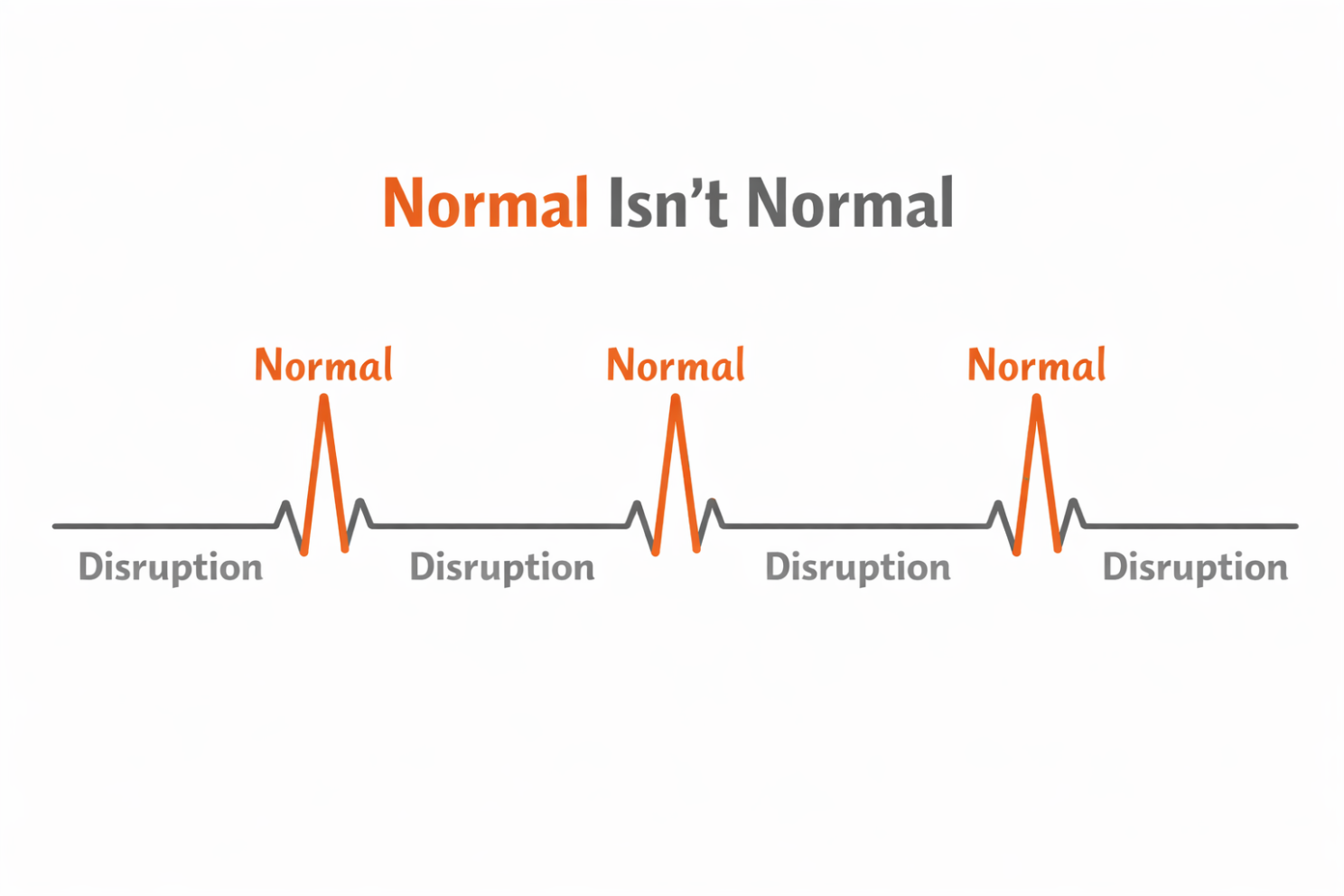
And that’s why I’m allergic to the word “disruption.”
We reach for it when the world doesn’t play by our rules. But if the world never does, what does the word really mean?
Here’s why I think this question matters:
When we believe that disruption should be rare, we set ourselves up for profound frustration. And that frustration slows us down.
Remember, Plans are Useful Lies
When I help CIOs, COOs, and PMO leaders speed up their execution, the opening conversation almost always starts like this:
- “We’ve planned our projects for the next two years. But urgent items keep pushing the roadmap. We need to get our stakeholders aligned.”
- “Our priorities keep shifting. We built an intake form, designed a scorecard, built a roadmap…and no one uses it. Executive priorities keep piling on.”
- “We need a better way to control scope. We’re always discovering something new that needs to be done. Our PMs are staying on projects three months or more later than expected. Resource planning is a nightmare.”
Notice that all of these begin with the same basic frustration point.
These PMOs expect and desire stability. When they don’t get it, the first instinct is to seize control through more formal processes, more alignment conversations, more approvals.
Do you know your pace of change?
To be clear, I think better processes and clearer communication can work to build speed and discipline. But you have to design prioritization around your real pace of change (not your PMO’s desire for stability).
For example:
- For industries with frequent and sudden regulation changes, a two-year planning horizon may be unrealistic (except as a flexible roadmap).
- If urgent items or “requests” are popping up weekly, it could be because you aren’t resourced to execute on both big projects and low-effort, high-impact wins.
- Ongoing scope “discoveries” may be frustrating, but they could be a sign that your delivery approach is front-loaded, where it needs to be iterative.
When we treat disruption like a space invader, we skirt the real question: “Are we built for this?”
When teams constantly act like they want to sue reality for breach of contract, the accumulating disappointment and frustration become a distraction from what really matters: building resiliency.
High-performing teams recognize that disruption is the sentence, not the punctuation mark.
High-performing teams don’t waste energy trying to prevent disruption or change. They spend that energy building systems, culture, tools, and people that can withstand the shifts.
What does that look like?
Here’s the truth. “Best practices” won’t get you there. Not all the way.
Your reality is messier than that. You need to find the right practices. And that usually requires structured experimentation.
Agile teams are great at this. But you don’t have to be “doing Agile” to build that kind of resiliency.
The Agile Practice Everybody’s Sleeping On
Not for nothing, but from where I sit: Rhythmic retrospectives are the best thing to come out of the Agile movement.
And I don’t understand why more PMOs and teams aren’t doing them. Because retrospectives add three mission-critical cultural touchstones to your PMO culture:
Empiricism
You know what’s better than best practices? Practices you’ve proven work in your environment.
Retros give structure to experimentation. Your team identifies high-impact opportunities (one at a time) to improve or build resilience. They test them. They adjust based on results. With consistency, you end up with a continuously improving team that is ready to meet the moment.
And as a PMO, the best ideas bubbling up from teams can be standardized and tested at scale for org-wide impact.
Initiative
High-performing teams don’t wait for a moment of calm to clear the gutters. In fact, they don’t expect they’ll ever get one. Instead, they make improvement a discipline that happens whether or not the atmosphere is calm. That means improvement is happening always, not just when it feels convenient.
Connection
When a team has a track record of solving problems together, solving bigger problems (“disruptions”) becomes easier. Second nature almost. Teams drop the baggage that comes with the word disruption. They expect it to happen, and they know they’re ready for it.
No, Retros Don’t Have to Be Every Two Weeks
They could be weekly, biweekly, monthly, or even quarterly in some contexts. You can even do retros individually as a PMO Director or Leader by setting appointments with yourself to ask these questions:
- What are you seeing across the project teams?
- How might your leadership or decision-making be contributing to an issue?
- Or, how might your leadership or decision-making help chase an opportunity?
- What change or process adjustment could you implement and test?
- When will you check back in with yourself to determine if it worked?
“I Don’t Have Time for Retros.”
Okay. That’s probably a different discussion, but fair enough. If you can’t build rhythmic learning and experimentation into the culture, or can’t yet do it at scale, then at minimum:
The next time your team is “disrupted,” resist the urge to groan. Shift your team(s) to a mission control mindset, where everyone works together to plot next steps, one “next right thing” at a time.
Tell your team:
“This is our time to shine. We’re resilient, we’re tough, and we can handle this kind of stuff. Now: what do we do first?”