

How Much are Non-Decisions Costing Your PMO?
A few weeks ago, I ran a quick experiment with a roomful of engineering leaders. The object of the game was simple: Be the first person to correctly estimate the number of working engineers in Germany.
The rules:
- Each person gets only one guess.
- Every 40 seconds, I’ll review another clue—six in total.
- You choose when to lock in your answer.
A handful pounced after the first or second clue and sometimes nailed it. Most waited for the fourth clue and did respectably. About a quarter waited for all six clues…but by then the game was over.
Nobody in the last-minute group lacked intelligence or caution. They simply equated “more data” with “better odds.” In a benign guessing game, that’s harmless. Inside a project schedule, it quietly drains time, money, and goodwill.
So, Big Dumb Question: How much are our PMOs paying for all the guesses that never get placed? And the obvious follow-up: What can we actually do about it?
PMOs Play This Game Every Day—Only the Bill is Real
Every scope clarification, funding release, or charter sign-off that sits in a steering-committee inbox is the project version of “just one more clue.” Teams keep working—often on assumptions—while the meter runs.
In my experience working with stuck projects and stymied PMOs, I’ve seen schedule-driven projects take two or three months just ratifying a charter. Approvals, directional changes, and even feedback bounce around the steering committee’s inboxes while teams soldier on under shaky assumptions.
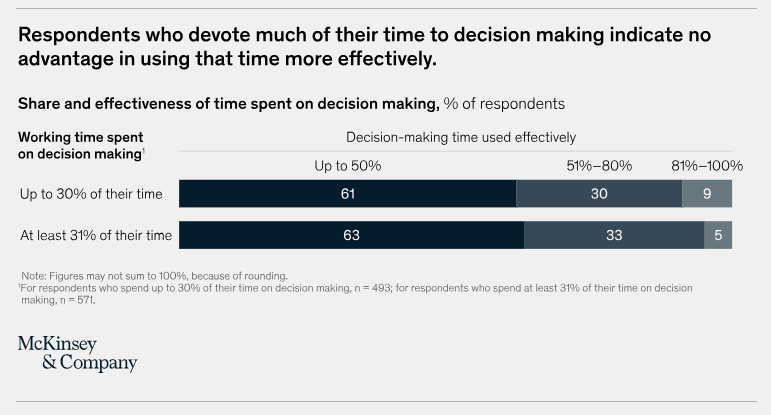
In researching this question, I learned my experience isn’t unique. In McKinsey’s global survey of 1,259 leaders, 61% say most of their decision-making time is used ineffectively. At an average Fortune 500 company, McKinsey estimates this could translate into more than 530,000 days of lost working time and roughly $250 million of wasted labor costs per year.
Caution is Deliberate. Inaction is Expensive Drift.
Planned caution means deciding at the last responsible moment. You know the stakes, you know the triggers, and you’ve budgeted the time. That’s good leadership.
Inaction is unplanned drift—no clear owner, no deadline, no escalation. And often no sense of how much it’s costing your PMO.
Drift taxes three ledgers:
The worst part is that decision-makers are often totally unaware of the balance sheet. And while PMOs have a “spidey sense” that decision latency is the problem, they often don’t have a way to prove it.
Three Sponsors, Three-Day Rule. Momentum Restored.
Many years ago, I worked with a client who was nine months into a “six-month effort.” They were only 25% complete, and they asked for my help getting them unstuck.
It was a massive initiative, with four sub-projects affecting 4,000+ employees and millions of dollars in assets. The pressure was on—and given that the team was talented, motivated, and invested, they couldn’t figure out why they were moving at a glacial speed.
I started by reviewing the schedule, interviewing the team, and speaking with each of the three executive sponsors. (Yep! There were three.) I learned something interesting. In working the math, nearly 12 weeks had been lost to delayed decision-making or approvals…a fact that had completely escaped the notice of the executives in charge.
Any time a decision was needed, all three sponsors had to be engaged. And then they had to agree—which, in this case, was difficult because their individual metrics for success were often at odds.
Here’s how we reset:
Together with the executive sponsors, we created a 72-hour decision SLA:
- A decision request unanswered in three days is auto-escalated to the CIO.
- “No” counted as a valid answer.
- We would track time-to-decision so that sponsors could see their own scorecard and troubleshoot slowdowns.
Momentum snapped back. We re-chartered into smaller chunks with crystal-clear “definitions of done” and finished in 10 weeks. The lesson for me: multiple sponsors aren’t necessarily fatal. But unstructured decision-making is.
Does Collaboration Slow Decisions Down?
You would think so. I definitely thought so, walking into that client with three sponsors. But I’ve been surprised to learn that you can be both collaborative and fast—with the right framing in place.
In fact, some research from BDO Consulting (reported in MIT Sloan) suggests that pushing decisions forward by “selling” your perspective can actually lead to endless arguments rather than good, fast decisions. When selling behavior is the most prevalent influence type in an organization, it’s 40% more likely to report that, after getting others to agree, they later realized a different course of action would have been significantly better.
True velocity doesn’t come from bulldozing a position. It comes from structured collaboration inside a time-box: debate hard, fast, and transparently. Then commit.
Five Moves that Cut Latency (Without Cutting Corners)
As a consultant with the privilege of working with a wide range of companies, I have the opportunity to continuously pressure-test tools and techniques. To this day, I’m still learning more about what works (and what doesn’t).
But here are five practices that I’ve found work well for most clients who are trying to cut decision speed:
- Create a Decision-Making SLA. Decide on the standard time-to-decision for different decision types and approvals. For decisions you can anticipate making, build approval times as explicit line items in your schedule.
- Build a Brief. Establish a 5-slide decision brief up front that you can use over and over again (without reinventing the wheel) to quickly frame up decisions. A format I like: Slide 1 Question, 2 Stakes, 3 Options, 4 Recommendation, and 5 – Trade-offs. Data lives in an appendix.
- Track the Lag. Add unbaselined decision-delay tasks to the schedule whenever an approval takes longer than expected. Adjust dependencies so the impact of this delay is clear, easy to tally, and easy to communicate.
- Co-Solve the Blockers. Every stakeholder has a unique decision-making style, and unique drivers built into the job function. Ask them: What would help you say yes/no faster? Adapt.
- Do #1-4 From the Very Beginning. PMOs obsess over risk registers, yet decision latency rarely shows up as a plotted threat. Don’t wait until decision latency becomes a problem to establish expectations. Treat it like any other preventable risk, and mitigate it ahead of time. That buys back the contingency for risks you can’t see coming.