

ICYMI: About This Report
PMI’s 2026 PMO Strategic Partners Report tries to answer a fairly straightforward question:
Do PMO leaders and the senior leaders accountable for project delivery care about the same things, to the same degree?
To answer that, PMI surveyed just over 1,900 respondents globally and paired the data with 40+ interviews. A little over half were PMO leaders.
The rest were what PMI defines as Senior Leaders—director-level and C-suite executives accountable for project delivery.
The report surveyed both groups separately about the PMO capabilities they believed were most important, and how resources should be allocated across those capabilities. Then they compared responses to identify gaps.
A nerdy detail about the data:
PMI used a MaxDiff methodology instead of traditional ratings. Respondents were repeatedly shown small sets of PMO capabilities and forced to choose which mattered most and least. The goal was to surface real tradeoffs—the kind leaders actually make when time, money, and attention are constrained.
The Report in Two Charts
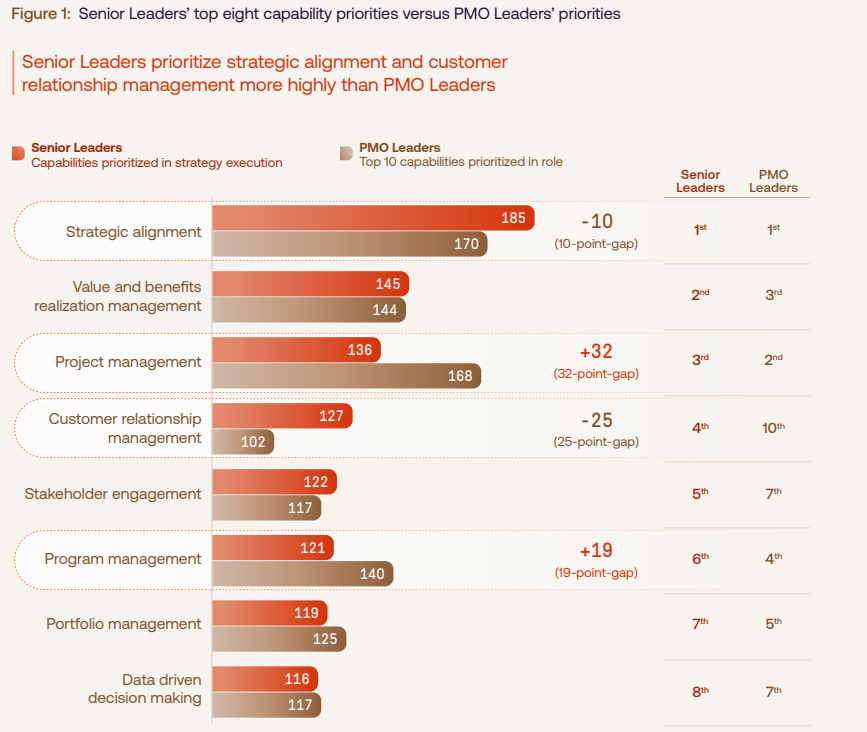
Most of the findings come from these two charts comparing PMO and Senior Leader responses on how capabilities should be prioritized and resources should be allocated:
Capability Gaps
PMI noted significant gaps in how PMOs and Senior Leaders prioritized:
- Strategic alignment
- Project management
- Customer relationship management
- Program management
Resource Allocation Gaps
PMI noted significant gaps in how PMOs and Senior Leaders prioritized:
- Strategic alignment
- Value and benefits realization management
- Customer relationship management
- Data-driven decision-making

Things that Make Me Go “Hmmm…”
Before we go any further, I should say that what first stood out to me was the muddy nature of the capability definitions.
See if you can pinpoint the difference between these two capabilities:
- Stakeholder Engagement. “Managing relationships, perceptions, and communication with stakeholders to align interests and achieve positive outcomes.”
- Customer Relationship Management. “Building and maintaining strong internal and/or external customer relationships and responding to changes in needs.”
Pretty similar, right? Now consider the vocabulary each uses in their work.
- “Stakeholder” is a project management term and the likely go-to for PMOs.
- “Customer” is the word many business leaders would use to refer to the same groups.
If respondents meant the same thing but used different words, the gap here may not be as dramatic as it appears.
These muddy distinctions occur in a few other places in the report, making a careful read vastly more useful than a superficial one.
7 Important Takeaways from PMI’s “PMO Strategic Partners” Report
1. If PMOs are “customer-centric,” why do they keep forgetting half their customers?
To me, the most revealing part of the report is who PMOs think their customers are:
- PMOs most often identify the C-Suite and project managers as their primary customers.
- Notably fewer list functional managers, project teams, or external partners/clients.
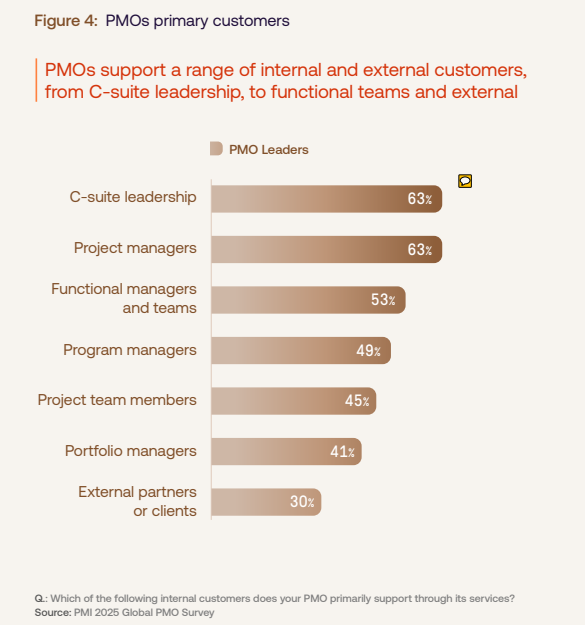
But in real organizations, those “secondary” stakeholders experience PMO decisions constantly, related (at minimum) to prioritization, change, resource allocation, and delivery expectations.
When they’re ignored or underserved, everybody feels it.
- Project work slows down.
- Meetings get longer.
- Changes multiply.
This is the real issue I see with PMOs:
PMO leaders believe their primary objective is to earn executive approval—then support the project managers in service of that goal.
The relentless focus on executive perception leads to prettier dashboards, polished steering committee presentations, and meetings before meetings to “align on messaging.”
It does not lead to faster, smarter progress.
And when PMOs care more about looking effective than being effective, middle managers are the first to notice it.
2. Executives want to stop talking about project management.
There was a 32-point gap between how much PMOs and Senior Leaders prioritized “project management” as a capability.
Huh? How can Senior Leaders believe that project management isn’t central to a PMO’s capabilities?
I think one of three things is going on:
Theory 1: Senior Leaders believe that project management is table stakes and does not warrant explicit mention.
Theory 2: Project management is important, but more Senior Leaders prioritize Program or Portfolio Management. (But worth noting is that PMOs and Senior Leaders prioritized these roughly equally.)
Theory 3: Executives equate Project Management with particular practices, artifacts, and mindsets—which they view as irrelevant.
Theory 3 is the most interesting to me.
I find it to be true over and over again in my own work with executives. And it’s why when I talk to them, I rarely use the term “project management.” Instead, I talk about strategy execution.
Not because I’m ashamed of the profession, or because I don’t believe solid project management practices work.
It’s just that most leaders I speak with associate “project management” with its accompanying practices, processes, and vocabulary.
And leaders perceive those practices as worthless if their teams can’t move at the speed of the strategy.
The CEOs and CIOs I speak with couldn’t care less whether you use a Charter, a burn chart, or a resource-loaded schedule.
Execs just want their teams to execute fast, smart, and responsibly so the organization can create value (or pivot from failure) sooner.
PMOs that win have stopped chasing “best practices.”
Instead, they’re laser-focused on finding the “right-for-them” practices that enable faster, smarter, more responsible delivery.
3. Let’s accept it. PMOs will always live in tension—because someone has to stand between ideas and reality.
By the time an initiative reaches execution, leaders are often already focused on what’s next. PMOs, meanwhile, are managing the risks that could erode value—missed benefits, adoption failures, security exposure, operational drag, or sunk cost.
This difference in time horizon creates tension: executives push forward, while PMOs slow down to protect against value loss. Neither role is wrong, but the disconnect explains why PMOs often feel like brakes rather than enablers.
And it’s why “Theory 3” (above) doesn’t feel so far-fetched to me.
Here’s why recognizing this matters.
When PMOs focus on making their projects look good (see #1), they usually sacrifice transparency to do it. But transparency is the one thing that will give executives confidence that the PMO is on their side, pushing to turn concepts into realities at the fastest responsible speed.
4. The finding about allocating resources to “Strategic Alignment” is…weird.
Much is made of the 10-point gap in how PMOs and Senior Leaders believe resources should be allocated to “strategic alignment.”
Both rank it high. It’s just that Senior Leaders rank it higher.
Here’s why I’m not sure this is a problem. To PMO leaders, strategic alignment isn’t usually a discrete activity that they fund with a budget line or staff allocation. It’s embedded in judgment calls across prioritization, sequencing, tradeoffs, and escalation.
Asking PMO leaders to translate it into people, time, and money makes the gap look larger than it is and risks misreading intent. The more useful signal is that both groups say alignment matters—just not in the same measurable way.
5. Executives want PMOs to prioritize AI as a workforce multiplier. PMOs are dragging their feet.
Senior Leaders view AI as a way to increase speed, surface risk sooner, and expand organizational capacity. (Though worth mentioning is that most senior leaders I speak with have no idea what that means in practice.)
Unfortunately, too many PMOs are experiencing AI as a threat to roles, relevance, or headcount. That mismatch drives hesitation and defensiveness instead of experimentation.
But the longer PMO leaders delay the transformation to an AI-powered PMO, the more those same leaders will struggle to lead credibly in this space.
Want to dip your toe in? I’ve written about the AI-powered PMO here:
- AI is Changing the PM Job Description. Here’s How PMOs Can Lead the Shift
- What Will AI Do to Project Management?
- Move Past Beginner Fluency: A Practice Pack for Project Management Professionals
- Are PMOs Ready for Radical Transparency?
6. The PMOs who would love to embrace AI innovation are hamstrung by IT.
Okay, this one’s mine.
But I think it’s key to understanding why PMOs might be struggling to integrate AI into their work. Here it is:
PMOs are being told to innovate with AI while being constrained to enterprise-approved tools (like Copilot) that lag far behind what’s technically possible.
I saw this post this morning and had to laugh. It’s true. Even on basic tasks, Copilot’s output is markedly worse than that of other models.
Look: Careful, responsible, and secure AI adoption is an imperative, particularly for large enterprises. But it’s also leaving PMOs unprepared for what’s coming.
Most PMOs I speak with are just beginning to use GenAI for relatively bounded tasks—drafting charters, outlining PowerPoint decks, or writing routine communications. Some are starting to hear pitches from SaaS vendors whose products now include an AI component.
PMI’s research seems consistent with that. Check out what it lists as the Top 5 Most Impactful GenAI Tasks:
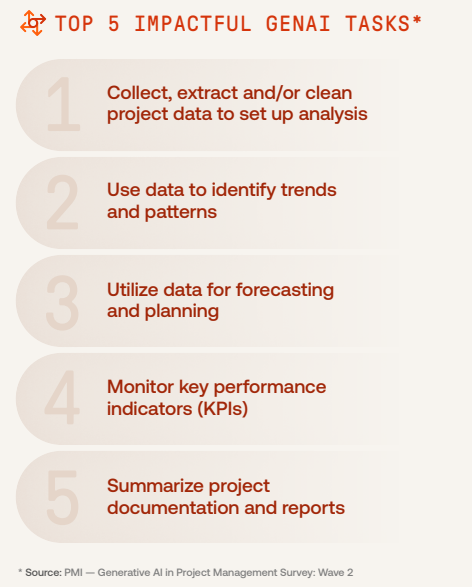
But I think most PMOs are totally unprepared for what agentic AI will do to the profession. And those who are reading the tea leaves are uneasy.
That posture won’t age well with Senior Leaders. Neither fear nor unpreparedness tends to inspire confidence.
PMO leaders need to move to intermediate AI proficiency as quickly as possible. Unfortunately, that’s not easy.
As I’ve written about here, there’s a dearth of help for people who “get” ChatGPT but go “huh?” at words like “agentic AI” or “embeddings.”
If there’s one place PMI has an opportunity—and a responsibility—to lead, it’s in moving the profession beyond basic LLM awareness and toward genuine future readiness.
7. “Not My Lane” is becoming a career-limiting move.
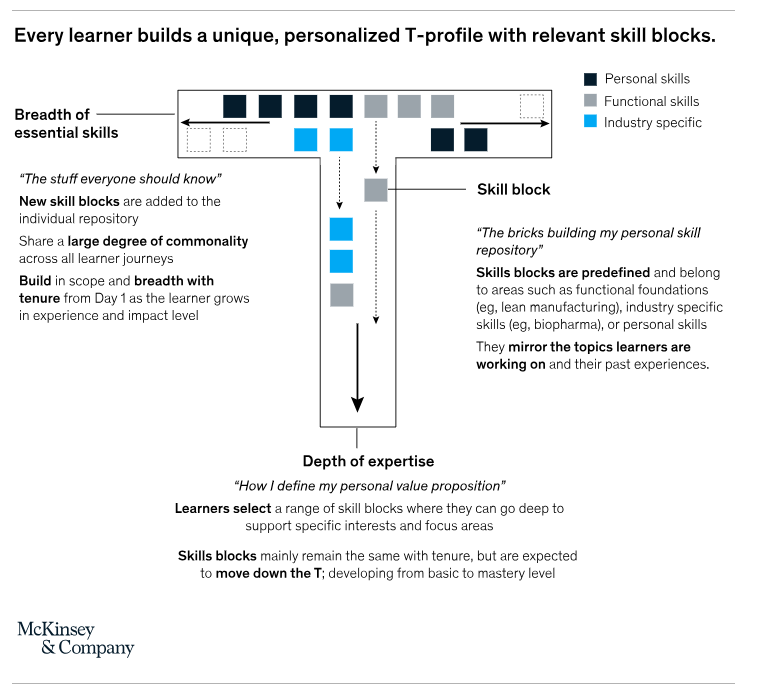
There’s a real push for PMs to gain data literacy and analytical capability, because it will get harder and harder to manage projects without them. And while the report specifically mentions those skills, I think PMs everywhere will need to start developing a “PM and _____” identity.
Future-proofed PMOs will be staffed by professionals who see themselves as generalists—capable of interpreting data, challenging assumptions, and connecting insights to action. Opting out under the banner of role purity is becoming increasingly risky.
My favorite way to think about the move to “specialized generalists” is using the “T-shaped employee” model (below). It’s a great way to talk to your teams about their development as the future shifts beneath our feet.
So, what’s your take?
PMI’s report offers plenty to chew on, but the real value lies in how we interpret and act on it. Whether you’re a PMO leader or a senior executive, the gaps highlighted here are a chance to rethink how we align, communicate, and execute.
If this commentary sparked an “aha” moment—or even a “hmmm…”—do me a favor: share it with someone who’d appreciate the insights. Let’s keep the conversation going and challenge the status quo together.
And hey, if you’ve got your own hot takes, I’d love to hear them. Connect with me here or DM me on LinkedIn, let’s talk strategy execution.