

Reorgs are meant to unlock progress. But too often, they do the opposite. Why?
If you’re not in the middle of a re-org, you’re probably recovering from one.
In a 2025 McKinsey survey of 2,000 global executives, half expected one to happen in the next two years. Two-thirds had just gone through one.
And they aren’t just reorganizing to save costs, which rarely work long-term anyway.
More and more, companies are redesigning their teams to improve throughput, increase their agility, and execute strategy faster.
Which leads to an important question: If reorgs are meant to propel us forward—why do so many of them do the opposite?
Why the Question is Trickier Than It Seems
Here’s something that may surprise you: Reorganizations are usually successful.
In 2014, just 21% of executives said their redesigns led to improved performance. Today, that number is 63%.
That’s a massive improvement—and a sign that restructuring teams (or even whole organizations) can be a powerful lever for faster execution.
But that still means that 37% of them failed.
Particularly for mid-size organizations, the impact of failure can be staggering—reaching far beyond the direct costs of implementation.
Instead of expediting strategy execution, these re-orgs:
- Inflict cultural harm
- Slow or stop progress on critical initiatives and
- Siphon goodwill from employees and customers.
So really, the question “Why do so many re-orgs backfire?” is incomplete. Here’s what we really want to know: When should a reorg be on the table? Are there less risky options? And what does it take to put my organization in the win column?
Before You Blame the Org Chart
When I work with companies to diagnose execution bottlenecks, it’s easy to see why structure gets the blame. Org charts are visible. Formal workflows are easy to map, analyze, and critique.
But there’s a problem: formal workflows—unless they’re automated or routinely audited—rarely reflect how the real work gets done.
When I sit down and ask the frontlines what’s in the way, I rarely hear suggestions about who should report to whom.
Instead, I hear:
- “We could move faster if executives would actually read our emails and respond.”
- “Our system has a 24-hour update delay, so I usually just call Humberto to get answers.”
- “I’m supposed to do the updates, but IT doesn’t want me to have access to JIRA—so I do a screenshare with Susan once a week to run through the tickets.”
In other words, while structural problems might exist, structural fixes are unlikely to work unless culture, process, tools, and skill gaps are addressed in tandem.
Instead of reaching for a re-org first, I usually recommend that companies first build a “clean lab.” That means identifying all the variables at play and addressing easy wins first—reducing the number of X factors that could cause bigger experiments to fail.
And often, once that noise is cleared, the reorg isn’t needed at all.
When Reorgs Make Sense
Sometimes, it really does make sense to reorganize teams or divisions earlier. To decide whether that’s the case, I use a Star Model to look at how all the various factors are influencing each other. Those factors fall into six buckets:
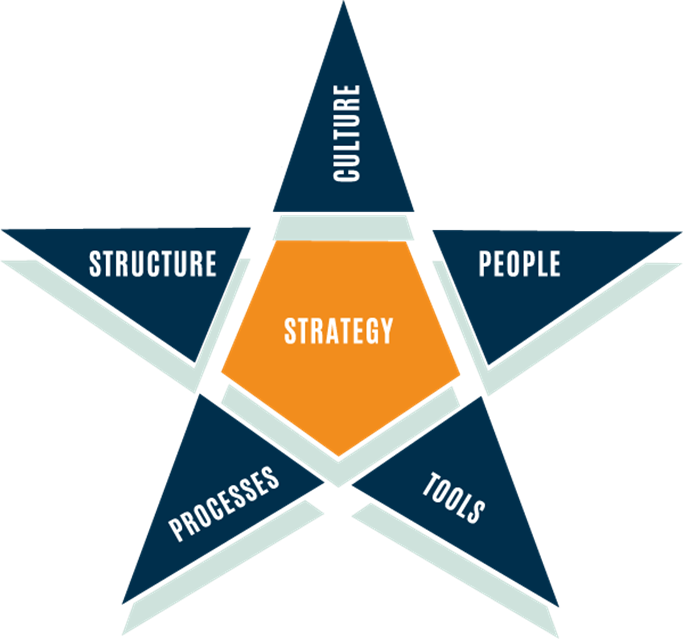
In the center, strategy. I need to know where your organization is headed—and how that’s different from where you are today.
Surrounding strategy, five key factors:
- Culture: The unwritten rules. What’s normal here—and what gets rewarded or avoided.
- People: The skills, mindsets, and capacity your teams bring to the work.
- Process: How work actually flows—from idea to action to outcome.
- Structure: Who reports to whom, how teams are grouped, and how power flows.
- Tools: The systems and technology that enable (or slow down) the work.
Once I lay these out, there are some scenarios where structural changes make sense as an early step.
Here are the Questions I Ask:
- Does the current structure introduce risk?
Sometimes, the existing structure leaves an organization vulnerable to risk—legal, compliance, reputation, security, or even customer vulnerabilities. When this is the case, it makes sense to shift the structure early. - Does the current structure reinforce cultural norms we’re trying to change?
If we’re trying to shift culture, stakeholder perceptions, or collaboration channels, we need to make sure that the current structure won’t get in the way.
For example, I often work with clients where IT and business teams struggle to collaborate. Putting them on the same team can help—but without clarity, coaching, and communication, structure alone won’t shift the culture.
- How much time are people spending circumventing the bad structure?
If the cost of workaround culture is rising—meetings, frustration, rework—it may be time to act sooner. - What else is the organization working on?
Opportunity cost is rarely considered—at least not to the level it should be. Every moment you’re spending rearranging people is a moment you’re not spending moving your most important strategic initiatives forward. - What else could solve the problem?
Hopefully, this is a question we’ve been asking since the very beginning. But it’s always worth a gut check one more time before committing resources to a big change. Can this be solved in another, less invasive way? If a lighter solution buys you a year or two, it might be worth trying before you commit big resources.
One Thing to Do Today
Before you talk structure, ask your team:
“What’s the smallest change we could make—without moving a single box—that would help us move faster or work smarter?”
You might surface a broken handoff, a hidden decision bottleneck, or a cultural blocker. And you’ll learn whether a reorg is really necessary—or just the most visible option.